

18 Total views, 18 Views today
By Fiona Crouch
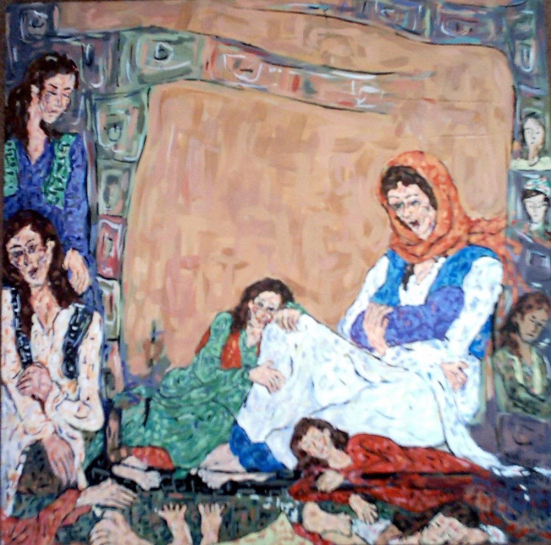
How should I start this review? From the outset, I connected with Sakar Faruq’s artwork. Yet, I still struggle to fully understand why. Her paintings are both enigmatic and starkly honest. This incongruity draws me in, but at the same time keeps me at arm’s distance. I feel as though I am both with the subjects but also their spectator. Perhaps her pieces highlight the ambiguity of women in today’s world – their apparent vulnerability that often belies their strengths. I think this juxtaposition unnerves me; making me question my own position in society and the roles I fill as a woman, mother, wife, employee, academic, writer…and me.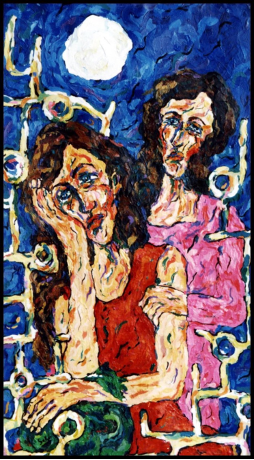
At first sight, I am reminded of Van Gogh, above all his portraits. Sakar’s bold and dramatic brushstrokes and use of strong colours seem to emphasise this similarity. Both artists’ work is redolent with movement and the sense of emotion that seeps from the canvas, invading my sentience. But then this familiarity fades away. Previously, in an interview, Sakar specified that Klimt inspires her, especially his exploration of the experiences of woman set in fantastical utopian realms. She does cede that many people comment on the Van Gogh resemblance. Is this because of the melancholic aura of Sakar’s artwork? Then I catch myself. By drawing attention to these similarities, I am doing Sakar, indeed, all female artists, a disservice. She is both her own woman and a talented artist in her own right.
Artists often overcome challenges to create. Sakar is part of this group. She was not born into a wealthy or artistic family. Instead as a young artist, she had to work to buy materials. Many people would hide this predicament, particularly as they become better known. Instead, Sakar openly discusses her early life in interviews. This honesty and detachment are translated into her artwork, and I am haunted by the female faces that peer at me from Sakar’s art.
Across the world, societies continue to be unequal. Overall, women complete most chores and remain the main child carers. The patriarchy still dominates. Unfortunately, many women are confronted every day by situations worse than the unfair distribution of housework. Sakar has recently commented that society is regressing and violence against women is increasing.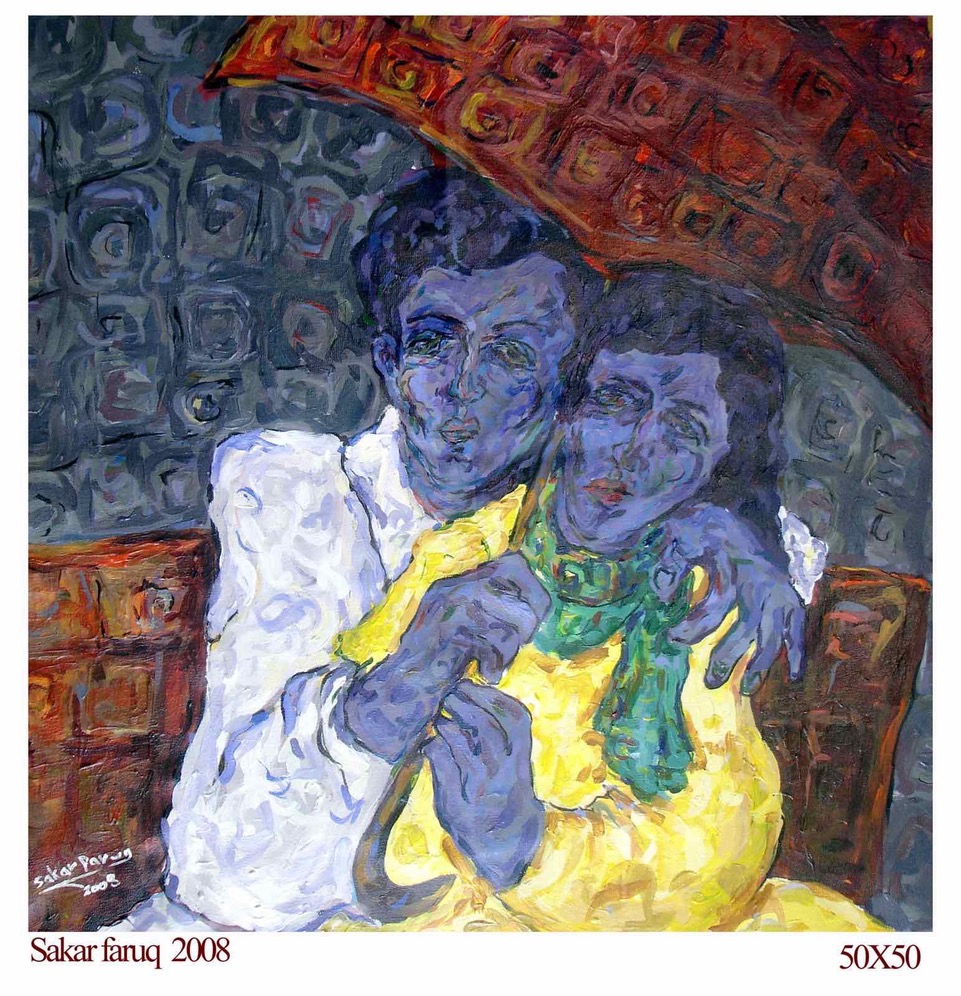
Sakar’s art is created from a woman’s perspective, with the aim of showing the woman ‘as human rather than only a body’. She hopes that her work challenges the burdens and expectations placed on women. The utopia she admires in Klimt’s work always seems to be just beyond the reach of Sakar’s subjects; their yearning for happiness shows in their watchful, mesmerising eyes. Sakar wants her artwork to go beyond the superficial; her subjects to be presented honestly. She strives to strip away the artifice that can mask a piece’s meaning to present an honest representation of what it is to be a woman. She says: ‘I wanted to show this side of womanhood too, broken, sadness and I want you to see her beauty in this too’. Her subjects are beautiful. They may be sad, but they are also defiant: their spirit will not be broken whatever obstacles they face. They are real and relatable. 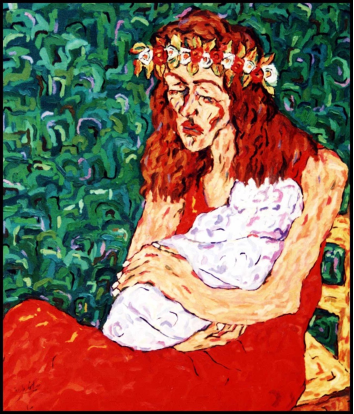
I want to set foot into Sakar’s paintings, to join the women in each piece. In her group pieces, the solidarity between the women is clear: a comforting arm around the shoulders as they stand side by side or curled up together as they face the world. She has created a sisterhood of imagined and real women: the line between subject and object blurs. Who is watching who? It is as though Sakar is with me. Will she take my hand to transport us into one of her pieces so that we can create the utopia dreamworld where all women are valued, and humankind is equal?.