2,303 Total views, 22 Views today
Zero Art by Avan Omar unfolds as an exhibition-research initiative presented at Casco Art Institute in Utrecht, the Netherlands, as part of its spring exhibition program. The exhibition opened on 11 April 2026 and is presented for a duration of two months. It is part of the group exhibition “Move Not for Reason but Love”, curated by Aline Hernández, Marianna Takou, Luke Cohlen, and Mirella Moschella, alongside works by Winnie Herbstein and Ama Josephine Budge.
The Zero Art exhibition foregrounds a collective artistic presentation centred on contemporary Kurdish art practices in dialogue with broader post-conflict and global art contexts. Bringing together a group of Kurdish artists, it highlights artistic responses to conditions of upheaval, resilience, and cultural continuity. Participating artists include Avan Omar, Rozhgar Mahmood, Samana Rash, Sherko Abbas, Walid Siti, Sira Shbr, Shirwan Fatih, Zana Rasul, and Hemin Hamid, whose works articulate diverse positions shaped by lived experience, displacement, memory, everyday encounters, and violence, as well as forms of artistic survival developed under conditions of limited institutional support. In parallel, a podcast component of the Zero Art project is presented with English subtitles, unfolding as a collective critical conversation among artists on contemporary art more broadly, and on artistic practices developed in Kurdistan in earlier decades. Participating in this dialogue are Rebeen Majeed, Zana Rasul, Soran Rafaat, Narmin Mustafa, Rahel Abduljabar, and Avan Omar.
Within this framework, Zero Art operates not as a singular authored statement but as a curatorial and artistic structure in which multiple practices coexist in relation to one another. Documentary materials—including images, sound recordings, interviews, and collective discussions—are embedded within the exhibition as an open and evolving archive. These elements are not treated as supplementary documentation but are integral to the exhibition’s epistemic structure, where artistic production, oral testimony, and archival fragments intersect to produce a situated field of exchange. The curatorial approach further frames archiving as a critical practice grounded in processes of reassembly, circulation, and interpretation. In this sense, the archive is not understood as a fixed repository, but as a dynamic field through which meanings are continuously produced and reconfigured. This approach disrupts conventional distinctions between artwork, document, and research material, positioning all components of the exhibition within a shared process of meaning-making.
Ultimately, Zero Art constructs a relational exhibition environment in which Kurdish artists’ works are placed in dialogue with one another and situated within broader international contemporary art discourses. The exhibition frames artistic practice as a collective field of negotiation through which questions of survival, transformation, and the reconfiguration of historical narratives are explored through artistic collaboration and exchange. Rather than operating as a collection of isolated works, it functions as an interconnected curatorial structure in which meaning emerges through relations between practices, materials, and voices, positioning Kurdish artistic production within wider global conversations on  contemporary art, memory, and post-conflict cultural expression. For more info please look at the web of Casco: move not for reason but love – Casco Art Institute
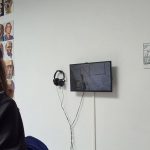
- Avan Omar, Interstice, 2024
Sound installation, headphones. Duration [—] (looped)
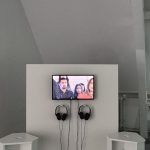
Intersti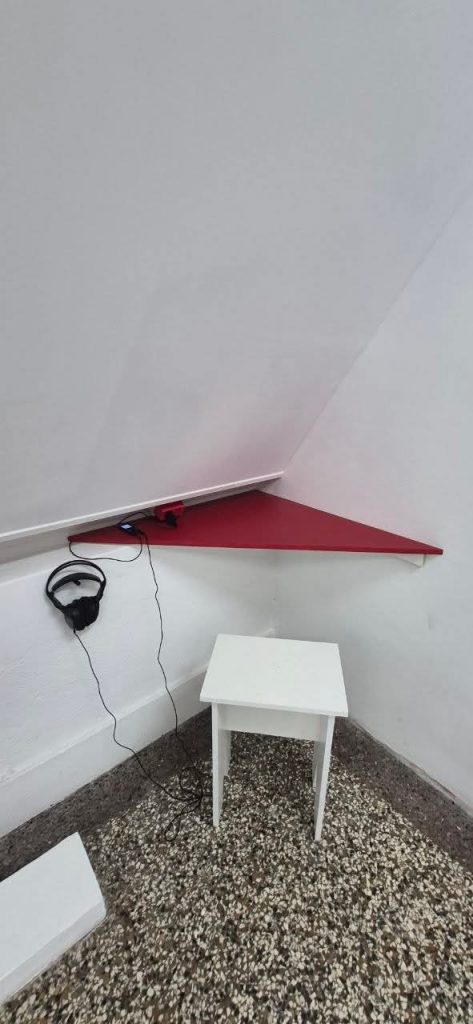 ce emerges from the subtle, often unnoticed sounds of thought, the “emmm,” “ehh,” and small hesitations that inhabit the spaces between words. During the production of the Zero Art Project podcast, these sounds were removed as interruptions, considered extraneous to the narrative flow. Gathered together, however, they form a rhythm of thought itself: a sonic residue of reflection, hesitation, and the unconscious. The installation invites listeners into a liminal space where silence and sound converge. Thinking becomes audible, revealing cognition in its raw, fragmented form. Each pause, each hesitation, embodies human subjectivity, a threshold between intention and accident. Interstice asks what emerges when the space between words becomes the focus, when listening shifts from seeking meaning to attending to thought itself.
- Printed book spreads from Zero Art line the corridor wall, situating the exhibition within its broader research context.
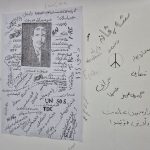
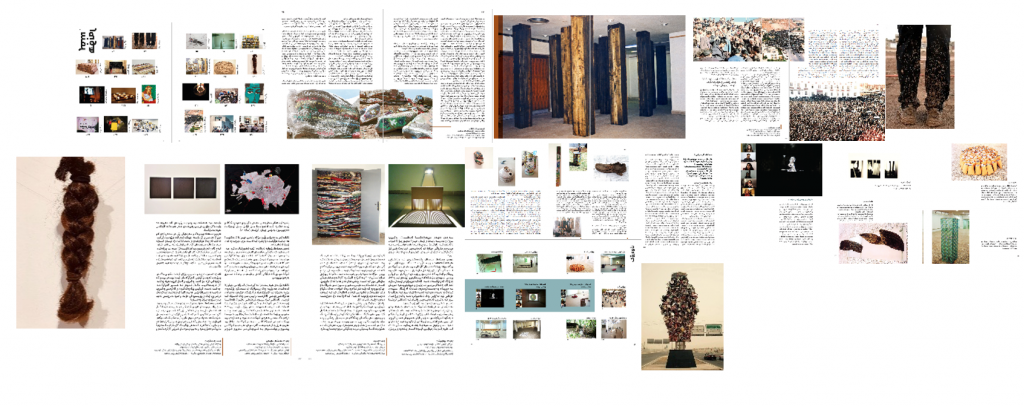 The enlarged pages displayed here are selected excerpts from the book Zero Arts. Written in Kurdish (Sorani), these pages bring together quotes, images, discussions, and reflections gathered throughout the project. They highlight the voices, concepts, themes, and contributions of the participating artists. Shown at this scale, the pages offer a glimpse into the materials that shape the Zero Arts books and the broader research behind the project.
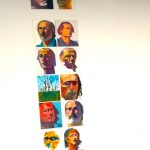
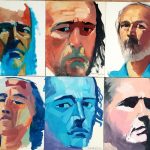
- Saman Rash, Rash – Self-Portraits, 2020
Ongoing, oil paintings, 30 × 24 cm
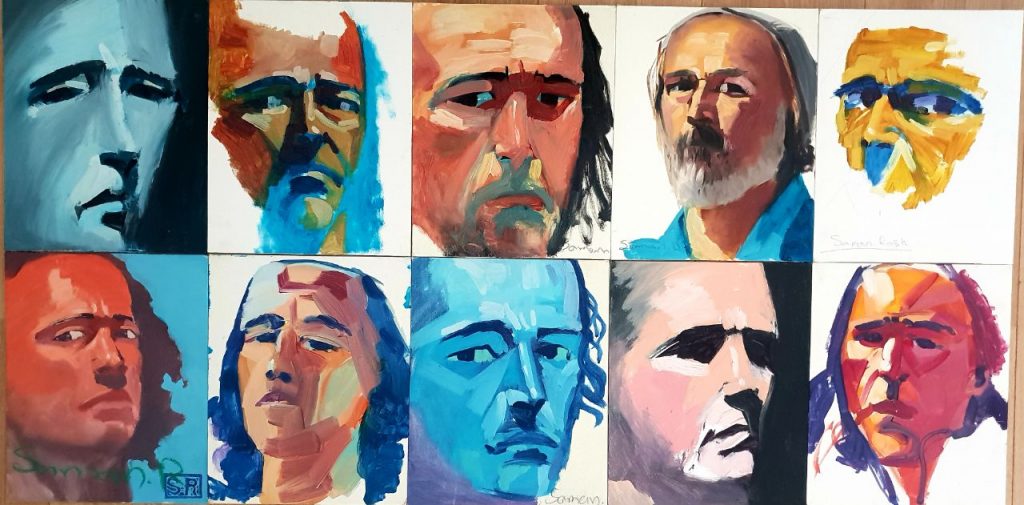
In this ongoing series of self-portraits, Saman Rash confronts the act of seeing and being seen, rendering his own face in oil with quiet intensity. Each painting becomes a meditation on existence in exile, capturing the rhythms of daily life and the weight of solitude in the countryside. Through repetition, the works evoke both the intimacy of self-examination and the estrangement of living apart from home, where memory and presence intertwine on the canvas. At the same time, they invite the viewer to feel an urgency to live fully in the present, rather than dwelling on the past or anticipating the future.
Saman graduated from the Sulaimany Institute of Fine Arts (1987). He has worked across subjects and materials while remaining committed to oil painting.
- Hemn Hamid Sharef, Representing Memory in the Citadel of Erbil, 2018
Video documentation of action, single-channel video, duration [—] (looped)
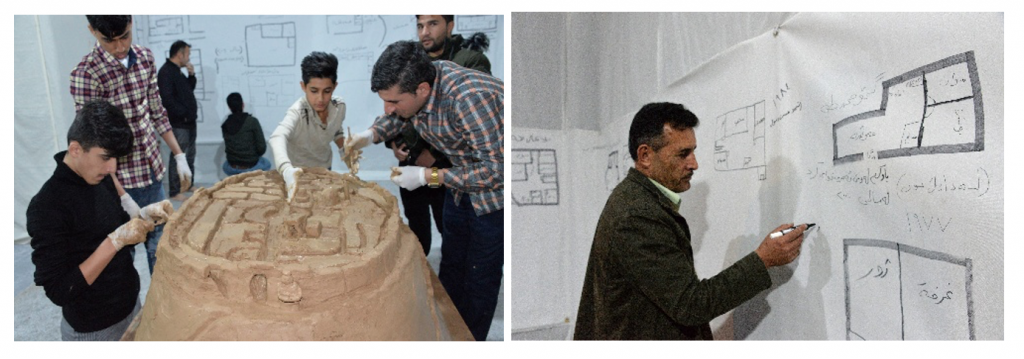 Representing Memory in the Citadel of Erbil is the culmination of a long-term process initiated in 2006, in response to the displacement of the Kurdish community from the historic citadel, one of the world’s oldest continuously inhabited sites, with a history spanning over 6,000 years. Evacuated under the pretext of restoration, residents were never permitted to return and were instead relocated to a newly built suburb known as the New Citadel. In this context, Hamed established a temporary gallery in two former shops, where participants collaboratively reconstructed their former homes from memory using mud and drawn lines, without relying on photographs or archival references. The process, documented through interviews, is presented as a video work that captures both the collective act of reconstruction and the social and spatial memory of the site.
Born in 1973 in Erbil, Hemn Hamid is a Kurdish visual artist and educator whose work explores themes of war, memory, and resilience. He teaches at the Erbil Institute of Fine Arts and works across installation, performance, and socially engaged art. His practice aims to disrupt the everyday and open space for new forms of contact, action, and interaction. Hemn graduated from the College of Fine Arts in Sulaimani in 2003 and holds a master’s degree in fine arts from the College of Fine Arts in Erbil.
- Avan Omar, Palimpsest of Rooflines, 2026
mixed-media installation, developed through a participatory workshop.
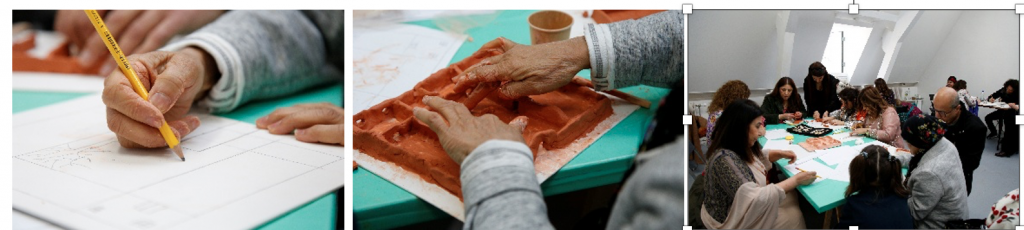
Palimpsest of Rooflines is an installation conceived through a workshop led by Avan Omar, held on March 15 during the Zero Art book launch at Casco, and further developed throughout the exhibition until its closing. Visitors were invited to participate voluntarily, recreating their (former) homes from memory using mud and drawn lines as expressive materials. The process unfolded organically, with the artist herself repeatedly sketching and reconstructing her own former home as part of the work. The presentation of the installation alongside Hamid’s Representing Memory in the Citadel of Erbil underscores the significance of this process, offering both inspiration and context. By placing individual memories side by side, private recollections were transformed into a shared landscape of belonging, opening space to reflect on the concept of home and the places we inhabit. As participants aligned their memories together, this collective act fostered connection, bringing people closer while mapping intertwined personal and communal histories.
- Archival Table. Newspapers, notebooks, photographs.
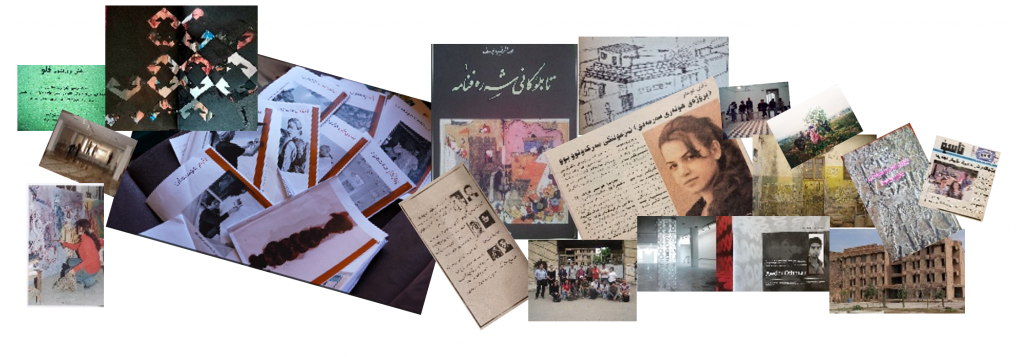 A selection of archival materials from the Zero Art Project, drawn from Avan’s personal archive and those of participating artists, presents a range of documents that trace the project’s development, exchanges, and artistic processes.
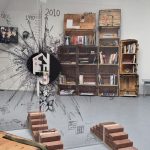
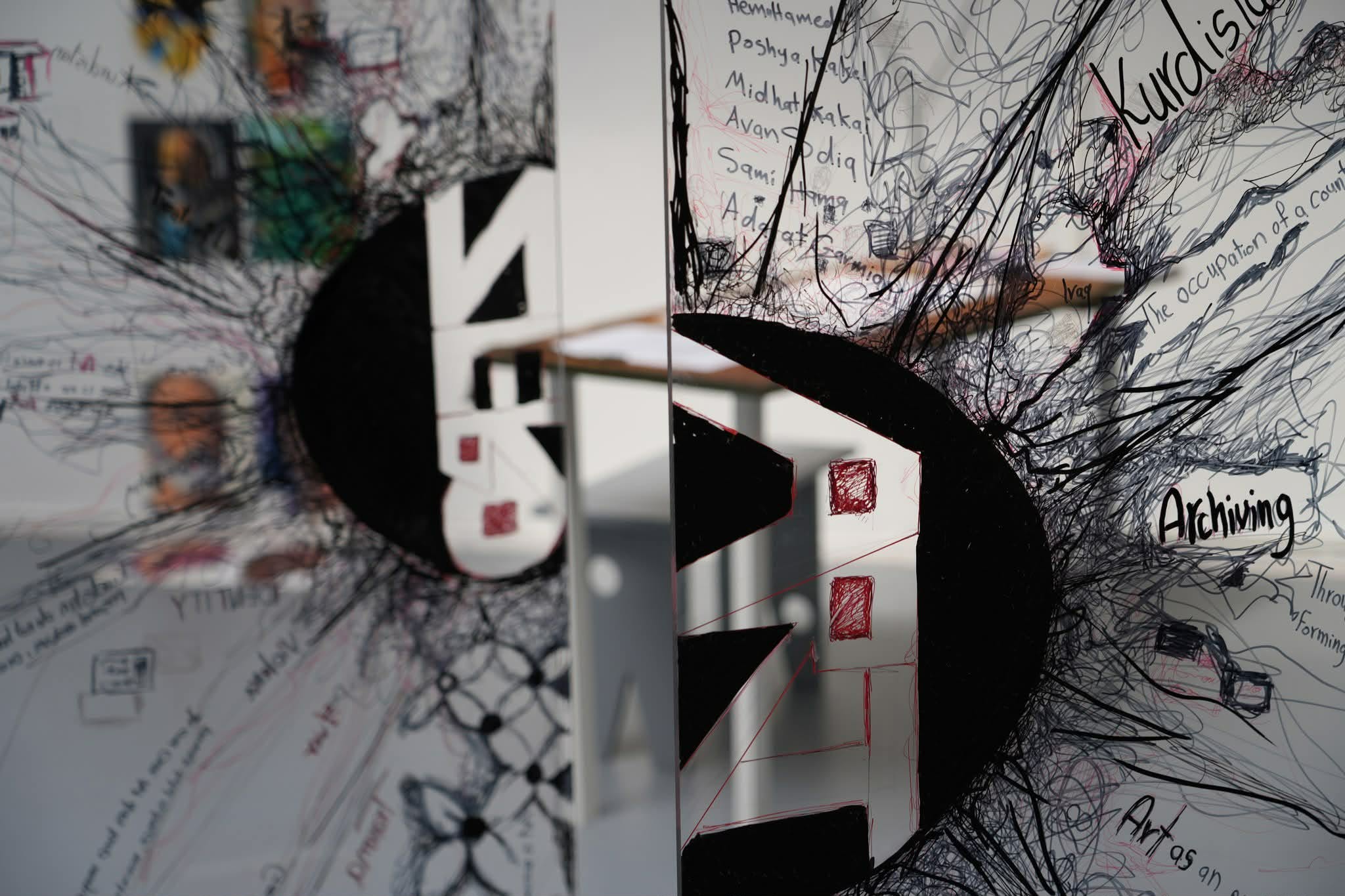
- Room Divider by Avan Omar. Permanent marker on Plexiglass and bricks. 165cm*100cm
This acrylic glass divider serves as a surface for sketches that trace the building, making, and thinking processes that form the archive behind the Zero Arts project. These pieces present the project through lines, diagrams, and mapped connections, unfolding in an open and exploratory way—through fragments, gestures, and comic-like notations. They are also acts of improvisation, responding to and interacting with the space in which the project is shown. Together, they reveal how ideas, connections, and questions took shape throughout the development of the project, and how the artworks and archival materials are represented within this space.
- Avan Omar & Rozhgar Mahmood, Untitled, 2008
site-specific installation (video documentation), 150 sqm, Sulaimany
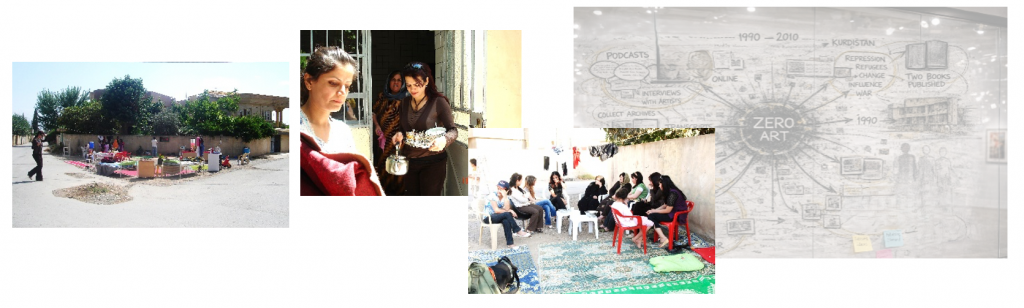
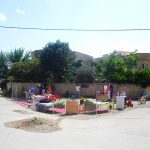
In this one-day intervention, Avan Omar and Rozhgar Mahmood transformed an abandoned lot in Sulaimany into a temporary open-air home. After clearing the site, they invited local women to contribute household items, arranging them to suggest the outline of a house, without walls or doors. The installation evolved into a fluid communal space, hosting spontaneous gatherings, conversations, and moments of play. The project challenged the boundaries between public and private, domestic and communal, while drawing attention to women’s limited access to public space. It also responded to the absence of institutional art venues in the region, proposing an alternative model of artistic engagement grounded in collaboration, memory, and social exchange. Rozhgar Mahmood is a contemporary Kurdish feminist artist. She holds multiple degrees in art and visual culture, including a Master’s in Visual Arts from Chelsea College of Arts, London. Working across video, performance, and text, her practice often transforms personal experience into conceptual projects. Active since the mid-2000s, she addresses issues such as war and gender-based violence through public performance and interdisciplinary experimentation, now, forming the primary material and impetus for his artistic work.
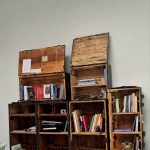
- Zana Rasool, The Library of Uncle Aishi, 2009
Mixed-media installation (wood ammunition boxes and books. (Reconstructed)
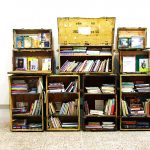
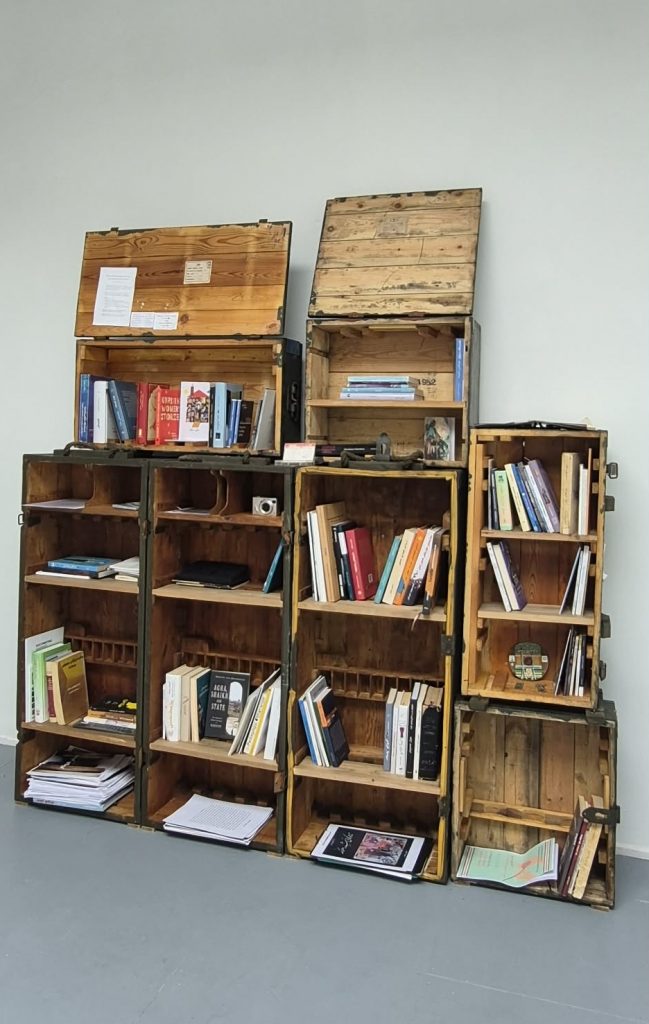 In The Library of Uncle Aishi, a series of bullet boxes is repurposed as containers for books, arranged to form a makeshift library. Rooted in childhood memories of an uncle’s house, the installation brings into proximity instruments of violence and vessels of knowledge, revealing their entanglement within histories of invention, progress, and conflict. Transforming these materials into a space of learning and contemplation, the work reflects on personal and collective histories, inviting viewers to consider how knowledge and destruction emerge from shared trajectories, and how memory holds these tensions. Zana Rasool began his art studies at the Sulaimany Institute of Fine Arts (1994–2001) and later graduated in painting from both the Institute and the College of Arts at Sulaimany University. His practice spans a range of media, including installation, performance, video, and text. Growing up as the child of a partisan, he did not experience a stable or conventional childhood; these memories now form a central source and material for his artistic work.
- Sirwan Rauf (Sira Shbr), Untitled (Self-Portrait Poster), c. 1990
Printed poster (reprint) 120cm*85cm
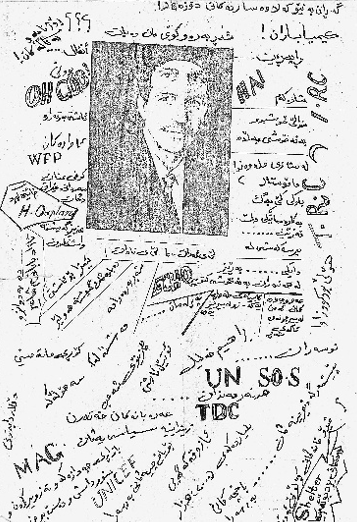
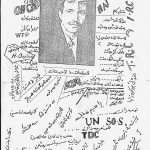
Untitled (Self-Portrait Poster) presents a haunting image of the artist with four eyes, symbolizing the heightened perception required to navigate life in 1990s Kurdistan, a reality too complex to be grasped with just two. Emerging from a period marked by hunger, civil war, and uncertainty, the work evokes a conceptual landscape shaped by endurance and survival. Scattered around the four-eyed figure are words that entered the Kurdish vocabulary during that time. These linguistic fragments act as markers of lived experience, embedding the socio-political realities of the period directly into the image. Through oral histories and photographic traces, the work preserves a vision forged under extreme conditions, where memory, language, and image intersect. Known as Sira Shabr, Sirwan Rauf was a self-taught Kurdish artist and Peshmerga (partisan) fighter from Sulaymany. Born in 1963, he joined the Peshmerga in the 1980s and was imprisoned by the Ba’athist regime for his political activism. After the Kurdish uprising, he turned to art as a form of resistance, becoming an experimental figure in the 1990s art scene. He died in 1999 at the age of 36, setting himself on fire in protest against the capture of Kurdish leader Abdullah Öcalan, leaving a lasting legacy as both a revolutionary and a pioneering artist.
Write the new vocabulary arriving in our world today, keep his work alive
- Sherko Abbas, Paper Puppet Testimony, 2019
single-channel video (VHS-HD), color, 8:17 min
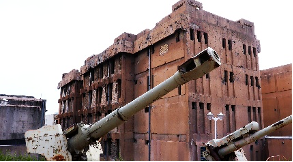 In this video work, Sherko revisits the 1991 Kurdish uprising through rare footage of the Red Prison in Sulaimany. While the prison has since been converted into a museum, the voices of female prisoners and the memory of a mysterious caravan filled with women’s clothing remain absent. The film challenges selective memory and brings attention to silenced narratives of sexual violence, reflecting on how history is constructed and mediated. Sherko Abbas is a Kurdish-Iraqi artist and filmmaker; he also works as a curator, organizer, and coordinator of cultural events. He was born in Iran in 1978, where his family lived as refugees. They returned to Iraq when he was two years old. Abbas studied Fine Art in Sulaymaniyah, Iraq, and earned a Master of Fine Arts degree from Goldsmiths College, University of London in 2015. His work explores sonic and visual memory, with a focus on modern memory that relies on recorded materials. Additionally, Sherko is interested in the current geopolitical situation in Iraq.
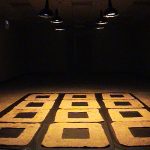
- 12. Sherko Abbas, Lbad, 2003
installation, 2 × 3 m in Origin. (Reconstructed)
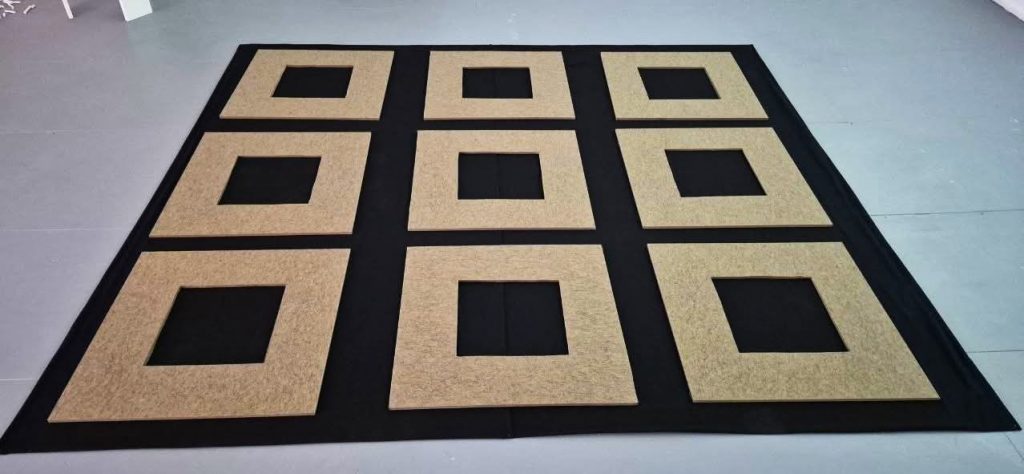
In Lbad (Felt), Sherko meticulously cuts the material with a sharp tool, removing any possibility of sitting or resting and transforming it into a purely sculptural presence. Traditionally, Lbad was used by Kurdish communities as a handmade rug for sitting and sleeping; Labd (felt) carries deep domestic and cultural significance. This precise intervention reflects a condition of instability, where certainty is unsettled, and the processes of thinking and planning are disrupted, foregrounding vulnerability and precariousness both materially and conceptually.
- 13. Shirwan Fatih, My Father’s Jacket, 2017
Documentation of performance and installation, 220 × 110 cm.
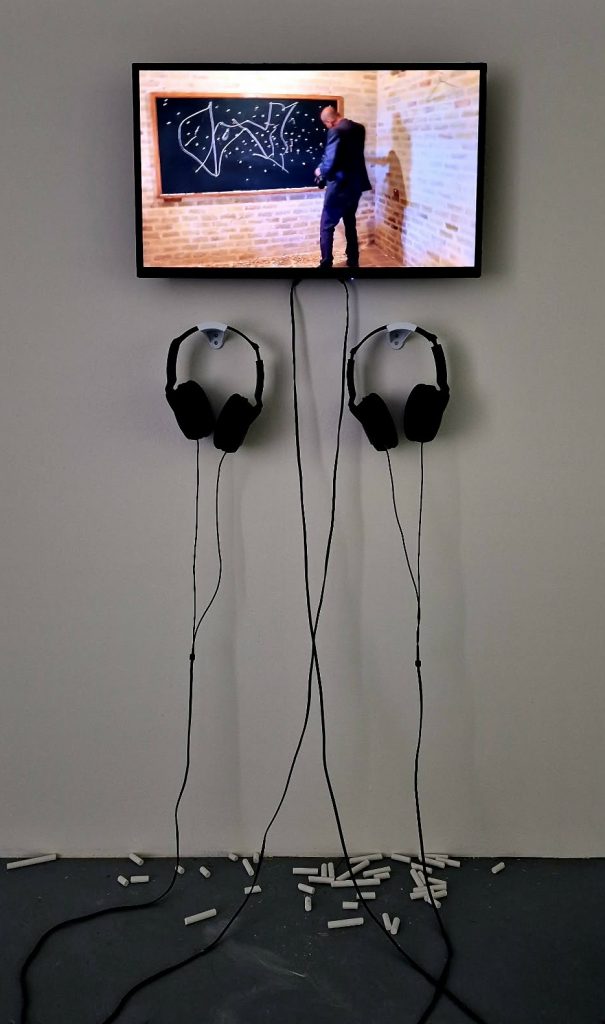 Shirwan Fatih, in this intimate performance, wears his father’s jacket, once belonging to a teacher who endured the economic crisis of the 1990s, while drilling into a blackboard and breaking chalk. The work unfolds as a meditation on the intergenerational transmission of trauma and resilience, inviting reflection on memory, education, and the subtle and overt forms
of violence embedded within both domestic life and institutional structures. Shirwan Fatih, based in Sulaimany, is a self-taught contemporary Kurdish artist working across installation, sound, text, and performance. His recent practice focuses on repurposing educational materials to question their role in shaping community values. Through these elements, he constructs works that critically engage social norms and open space for dialogue.
- 14. Avan Omar, Group Discussion on Critical Reflection in
Contemporary Kurdish Art, 2021
Podcast, 50 minutes.
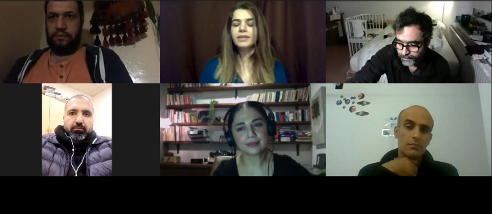
This online discussion, hosted through The Podcast Project’s digitall magazine -Culture Magazine and initiated by Avan Omar, revisits the 2004 workshop-exhibition 61.5 x 47.7x 58 at Aram Gallery, a key moment for a generation of emerging Kurdish artists. The conversation explores questions central to contemporary Kurdish art, including everyday materials, memory and identity, and critical reflections on institutions and education. It creates space for self-critique, examining the role of the artist and positioning artistic practice within broader social, cultural, and political contexts. Through retrospective reflection, the artists reassess their early works in relation to the transformations of Iraq and Kurdistan in the early 2000s, while also engaging critically with dominant Eurocentric models. By 2021, their trajectories had dispersed internationally, highlighting the shifting positions of Kurdish artists across local and transnational contexts.
Participating Artists: Rahel Jabaar, Rebeen Majeed, Narmin Mustafa, Soran Rafaat, and Zana Rasool
- 15. Walid Siti, The Troubled Bear and the Palace, 2019
Single-channel video (VHS-HD), color, 10:28 min
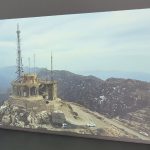
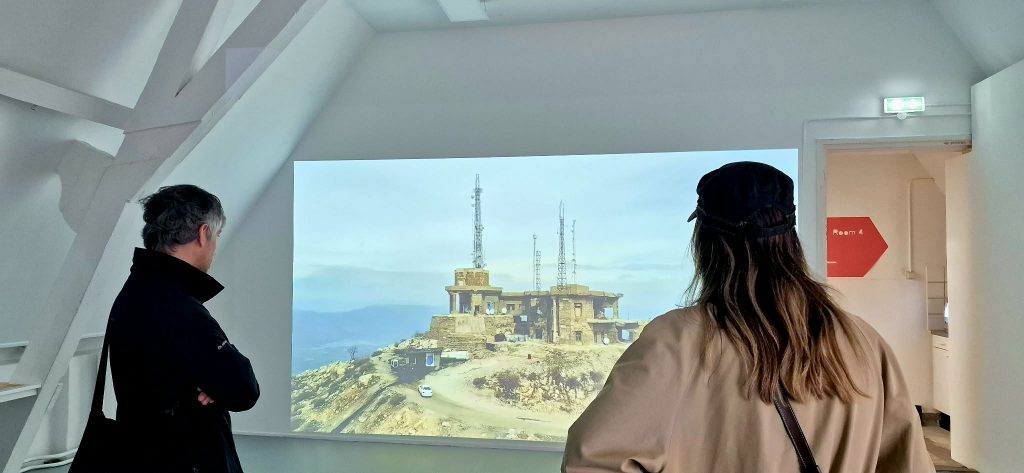 Walid Siti, in this poetic video set in the ruins of a Saddam-era palace on Mount Gara, reflects on the aftermath of authoritarian rule. Two bears, released into the wild by animal rights activists, remain confined within an ecologically damaged environment. The palace, once a symbol of power, now lingers as a haunting presence in the landscape. The work reflects on the enduring scars of dictatorship, inscribed onto both land and life. Walid Siti (b. 1954, Duhok, Iraqi Kurdistan) is a UK-based Kurdish artist whose work explores memory, displacement, and identity. Trained in printmaking, he studied at the Institute of Fine Arts in Baghdad and he continue his arts education in Ljubljana, Slovenia before seeking asylum in the UK in 1984. Siti works extensively in a variety of mediums, including video, installation, 3D works, work on paper, and painting. His practice draws on the cultural heritage and political landscape of his homeland. His works traverse a complex terrain of memory and loss, while at the same time offering an acute insight into a world, which for him has been a place of constant change. His work has been exhibited internationally
- 16. Avan Omar, Hawar, multimedia, 2017, Casablanca (Morocco)
2021, Sulaimany (Kurdistan). 10 minutes ( video documentation)
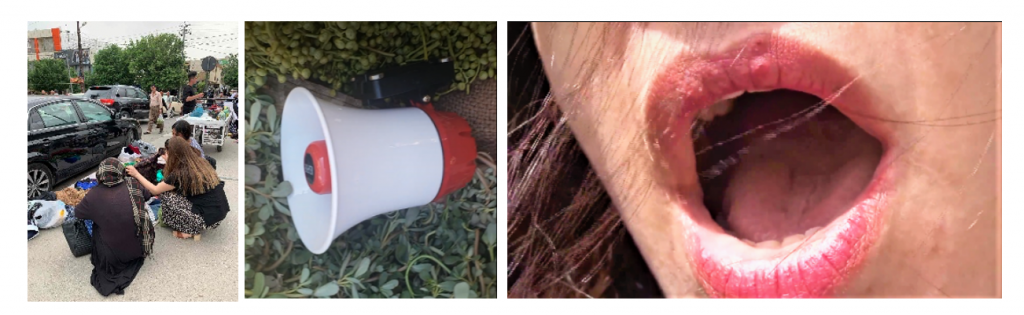
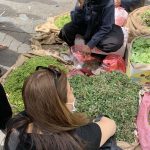
Hawar, meaning yelling, shouting, or screaming, explores the politics of voice in public space, focusing on gendered silences. While vocal expression is fundamental, women’s voices are often marginalised. In marketplaces across Casablanca and Sulaimany, men dominate the soundscape, while women remain largely unheard. During field research in Casablanca, the artist observed women using the clatter of spoons to attract attention, rarely raising their voices. Developed across both cities, Hawar responds through performative and participatory actions. In Casablanca, the artist performed with her voice in front of a mosque, with the sound of the call to prayer. In Sulaimany, women were invited to use speakers to assert their presence, while recordings of the artist’s voice moved through the city. By foregrounding women’s vocal presence, Hawar examines the mechanisms that privilege male speech, transforming shouting into a strategy of visibility, resistance, and collective expression.
Avan Omar is a multidisciplinary visual artist whose practice critically engages with the politics of memory, archival epistemologies, and the entanglements of identity within geopolitical landscapes. She graduated from the College of Fine Arts in Sulaimany and holds a Master’s degree from the Dutch Art Institute (DAI) in the Netherlands (2017). Grounded in a diasporic Kurdish context, her work examines how collective and personal histories are mediated, constructed, and contested through visual and material forms. Omar’s methodology approaches the archive not as a static repository, but as a dynamic and often unstable terrain in which absence, fragmentation, and erasure shape both the aesthetics and ethics of representation. Working across performance, mixed-media assemblage, and installation, she interrogates the mechanisms that govern historical visibility and invisibility, employing repetition, layering, and spatial disruption as key formal strategies. Her practice is informed by postcolonial theory, memory studies, and critical geography, offering a nuanced reflection on displacement, resilience, and the speculative reconstruction of suppressed narratives. Omar’s work has been exhibited in both institutional and independent art spaces internationally, contributing to broader discourses on art as a mode of counter-historical production and cultural resistance. Her recent projects include These People Are Working and the long-term research initiative Zero Art.
The Commons as a Guiding Principle of Casco Art Institute
Casco Art Institute: Working for the Commons is built around the idea of “the commons” as both a social practice and an artistic method, where art is used to explore and prefigure non-capitalist ways of living together. Its ideology centers on collective “commoning”—shared, participatory processes that treat knowledge, resources, and cultural production as communal rather than private property. Through experimental, process-based art projects and institutional self-experimentation, Casco aims to create a more equitable, decolonial, and sustainable model of society, using art not just as representation but as a tool for organizing, imagining, and practicing alternative social relations.